
Give the collection a historical purpose
A folder of old campaign materials can document how people described families, institutions, and public policy at a particular moment. Its value does not depend on presenting the material as current advice or asking a new reader to adopt its original message. Begin by stating the collection's historical question and the period it covers.
A contemporary example is Duke University's February 17, 2012 report, which identifies the Coalition to Protect All NC Families as an independent group involved in the North Carolina Amendment One debate. [1] That dated record helps establish context. It does not demonstrate the present ownership of an old campaign domain, the continuation of an organization, or the current availability of services once described in related material.
Identify what kind of item you have
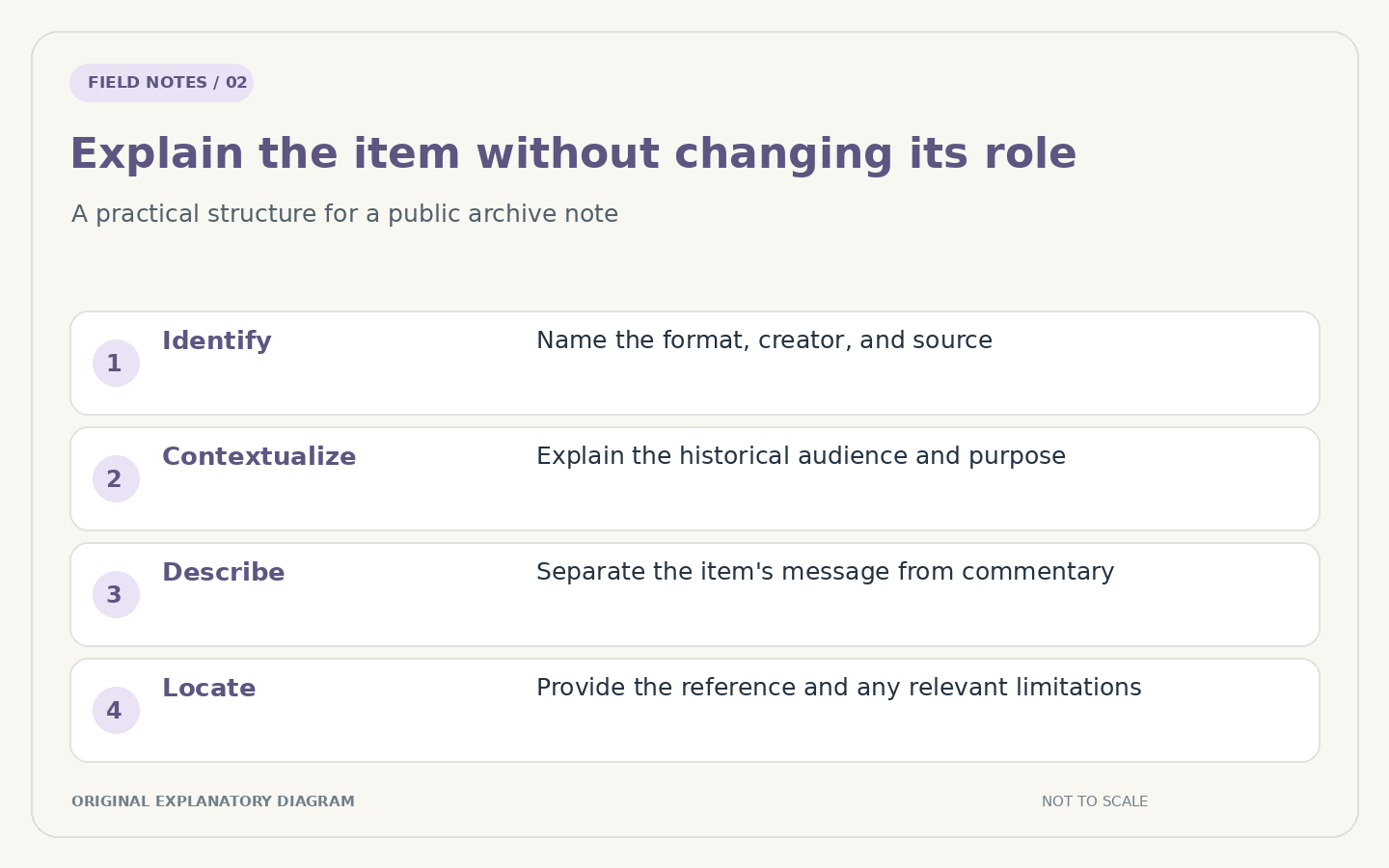
A public statement, a flyer, an event photograph, and a personal recollection provide different kinds of evidence. Record the format and the apparent creator before interpreting the message. If the creator is uncertain, preserve that uncertainty. A logo or copied heading may suggest an origin without establishing who produced the particular version in the collection.
The National Archives' document-analysis resources encourage examining a source's features and context before using it as historical evidence. [2] Turn that principle into a compact catalog record: item type, creator, date, audience, and known source. Keep description separate from interpretation so that a later reader can see which details came from the object and which came from the cataloger's research.
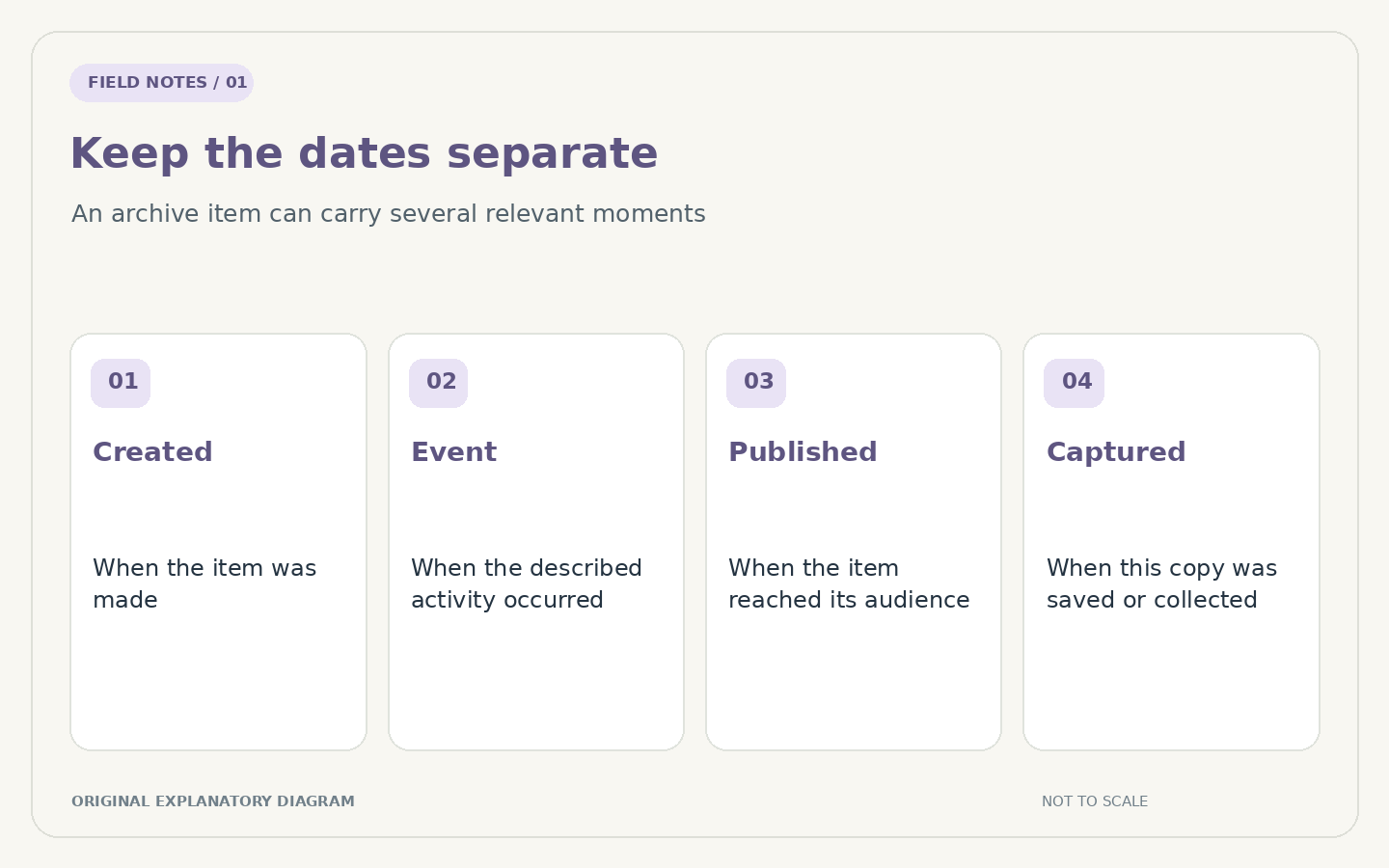
Build a timeline with more than one date
An item can have a creation date, an event date, a publication date, and a later capture or download date. These dates need separate fields when they differ. A screenshot saved recently may preserve a much older page; a photograph may have been published long after the event it depicts. Avoid letting the easiest available date stand in for all the others.
For an original timeline, place the event in one column and the evidence about it in another. Add a third field for the date of the evidence. This makes it possible to compare a contemporary notice with a later recollection without treating them as identical records. It also helps explain why a sequence may remain uncertain even when several relevant items have survived.
Describe a position without adopting its instructions
Campaign materials were created for a purpose. A historical description should identify that purpose and distinguish a quoted position from the archive's own explanation. It can state that an item urged a particular action in its original setting without repeating the instruction as a present request to the reader.
Use neutral catalog language that describes what the item is doing: announcing an event, presenting an institutional position, addressing a particular audience, or explaining a proposed policy. Avoid replacing the original context with a modern judgment that the evidence does not itself establish. The archive can make a document understandable while allowing readers to distinguish its historical role from the curator's account of it.
Keep the full item beside selected details
When highlighting a sentence or image detail, retain a reference to the complete item. A cropped excerpt may omit the date, qualification, author, or intended audience. The selected detail should therefore be accompanied by enough information to locate and understand the original. A visually striking fragment is not necessarily a self-contained historical statement.
An original editorial note can explain why a detail was selected and what it does not show. For example, it may illustrate the terminology used in a public statement without representing every participant's view. Do not assemble fragments from several items into a single apparent quotation. Preserve the difference between an original document and a new explanatory comparison.
Review personal information before sharing
An old public item may include names, contact details, or personal information that is unnecessary for the present educational purpose. Review the proposed publication as a whole rather than assuming that everything collected needs to appear online. The historical question should guide what is reproduced and how much identifying detail it requires.
A practical review can ask whether a person's name is essential to understanding the document, whether the information is already part of the relevant public record, and whether a less intrusive description would serve the same purpose. Where the judgment is uncertain, consult the institution or person responsible for the collection. This is an editorial responsibility, not a reason to alter the underlying record or hide what was changed in a displayed copy.
Separate historical policy from current arrangements
The Duke report includes a dated institutional statement about benefits and inclusion. [1] Its descriptions belong to that statement's time and organizational context.
A reader who needs present information about benefits, healthcare, or family-related services should be directed to the current responsible institution. The archive can preserve what was said without guaranteeing that a policy, contact person, or application route remains unchanged. In an educational display, a short note identifying the historical period is often more helpful than repeatedly warning readers in the main text. Make the distinction visible where the old information could otherwise be mistaken for a current instruction.
Present the collection through questions
A public presentation can be organized around questions about language, audience, institutions, and chronology. Invite readers to compare what different kinds of documents establish. The National Archives treats analysis as a foundation for using sources as evidence, rather than an endpoint in itself. [2]
For an original discussion activity, ask which detail anchors an item in time and which statement requires another source to evaluate. Keep participants focused on the evidence available in the collection. There is no need to invent a representative family story or ask anyone to disclose a personal experience. A carefully chosen comparison can make the historical subject concrete without turning the session into a campaign or a test of agreement.
Leave a collection that can be understood later
Finish with a scope note describing the period, kinds of material, and method of organization. Explain which items are originals, reproductions, transcriptions, or later annotations. Keep a record of missing information and changes to the catalog so that future additions do not silently replace earlier judgments.
A useful family-policy archive helps readers understand a public discussion in its own time. It also models a practical habit: separating an existing record from a present decision. That habit remains useful when families later organize support, communicate with institutions, or compare health information. The connection is careful, respectful use of information, not an assumption that a historical political document can answer every current question.
Sources
- Duke Reaffirms Its Position as North Carolina Considers a Ballot Measure, February 17, 2012 — Duke University, Duke Today
- Document Analysis — U.S. National Archives and Records Administration